
 Call Buderim
 Book Appointment

If you wear a partial denture, you may have noticed small metal or tooth-coloured components that wrap around or rest against your natural teeth. These are denture clasps, and they play a central role in keeping a removable partial denture stable during everyday use. Understanding how they work can help you make more sense of your own appliance and the choices involved in designing it.
Removable partial dentures rely on the remaining natural teeth to provide support and retention. The denture clasp is the component that makes that connection, gripping the abutment tooth (the tooth the clasp attaches to) at a specific point to hold the denture in place while still allowing it to be removed for cleaning. Clasp design is not one-size-fits-all, and several factors influence which type is selected for each situation.
Quick Overview
- A denture clasp is a small component of a partial denture that anchors it to the remaining natural teeth.
- People with partial dentures will often have clasps as part of their appliance, though the type used may vary widely.
- Clasps may affect how visible the denture is, how stable it feels, and how much stress is placed on the supporting teeth.
- Material, tooth position, and oral anatomy all influence which clasp design may be appropriate.
- The right clasp for your situation depends on a clinical assessment of your mouth.
Keep reading to understand the main clasp types, what influences selection, and what to know about caring for them.
What Does a Denture Clasp Actually Do?
A denture clasp secures a partial denture by engaging a natural undercut on the abutment tooth. Clasps generally have two main arms: a retentive arm, which flexes slightly as it passes the widest part of the tooth and then grips below it; and a reciprocal arm, which sits on the opposite side to balance the force. Most clasps also include an occlusal rest: a small extension that sits on a prepared groove in the biting surface of the tooth, preventing the denture from pressing down into the gum.
Together, these parts distribute the forces of chewing across the supporting teeth and help prevent the denture from lifting or shifting during use.
What Are the Main Types of Denture Clasp?
Clasp designs fall into two broad categories based on how the retentive arm approaches the tooth: those that approach from above (suprabulge or circumferential designs) and those that approach from below (infrabulge or bar designs).
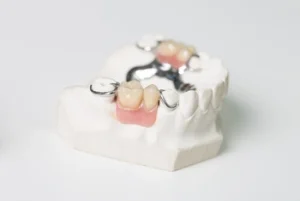 Circumferential clasps are the most commonly used design. The retentive arm originates near the occlusal rest and wraps around the tooth from above the survey line. They are reliable and straightforward to fabricate, making them a practical choice for posterior (back) teeth where aesthetics are less of a concern. Because more metal is visible, they are generally less suitable for front teeth or areas in the smile line.
Bar clasps, including the I-bar and T-bar designs, approach the undercut from the gingival direction rather than from the top of the tooth. This means less metal crosses the visible surfaces of the tooth, which can improve the overall appearance of the appliance. The RPI system (Rest, Proximal Plate, I-bar) is a specific bar clasp design that is often used on abutment teeth adjacent to a gap at the back of the arch, as it is designed to reduce the rotational stress placed on that tooth during function.
Combination clasps pair a wrought wire retentive arm with a cast reciprocal arm. The wrought wire is more flexible than cast metal, which can be useful where additional stress-breaking is needed, for example, on a weaker abutment tooth. This design gives the clasp greater flexibility while still providing the reciprocal support needed on the opposite side of the tooth.
Tooth-coloured clasps made from acetal resin or similar materials are an option where aesthetics are a priority. These materials can be matched closely to tooth colour, making the clasp far less visible in the smile line. Partial dentures can be made from plastic, metal, or both, and the choice of material involves weighing up your specific needs and the position of the teeth involved.
What Influences Which Clasp Is Chosen?
Clasp selection involves balancing several factors at once, and no single design suits every situation.
The position of the abutment tooth matters. A tooth near a visible part of the smile line may call for a bar clasp or tooth-coloured option rather than a conventional metal circumferential clasp. The location of the undercut on the tooth also affects which arm design can engage it effectively.
The overall support structure of the denture is another consideration. Partial dentures held in place by clasps depend on the condition of the teeth they attach to for fit and stability. Teeth with reduced bone support or existing restorations may need a different clasp approach from that of fully intact abutments.
Whether the partial denture is tooth-supported throughout, or whether it extends over a gap at the back of the arch with no rear tooth to anchor to, also changes the mechanical demands on the clasp. Extension base situations place more rotational stress on the clasp during chewing, which is why designs with greater flexibility or stress-breaking capability are often considered in those cases.
How to Care for Your Denture Clasp
Clasps need regular, careful cleaning around the point where they meet the tooth surface. Keeping dentures and natural teeth clean is an important part of protecting the overall health of your mouth.
Use a soft denture brush to clean around the clasps each time you remove the appliance. Avoid bending the clasp arms when inserting or removing the denture. Always follow the path of insertion your dentist demonstrated. If a clasp feels loose or the denture no longer seats correctly, avoid adjusting it yourself and book a review instead.
 A Considered Approach to Partial Denture Design
 A Considered Approach to Partial Denture Design
At Custom Denture Clinic, brothers Andre and Pierre bring over 25 years of individual experience in the dental industry to the fabrication of partial dentures. Clasp selection is part of a broader assessment process that considers the position of your remaining teeth, the location of missing teeth, your bite, and your aesthetic priorities. Individual outcomes depend on a range of clinical factors, all of which are assessed before any appliance is designed.
If you would like to discuss your partial denture options, call our Buderim clinic on (07) 5317 1023 or our Caloundra clinic on (07) 5315 8076 to arrange a consultation.
Frequently Asked Questions
Are denture clasps always metal?
Not always. While metal clasps, usually made from cobalt-chromium alloy, are the most common, tooth-coloured clasps made from materials such as acetal resin are also available. These are used when aesthetics are a priority, particularly in areas visible when smiling. The suitability of each material depends on the clinical situation and the location of the abutment tooth.
Can a denture clasp damage my teeth?
A well-designed and correctly fitted clasp distributes forces across the abutment tooth without causing harm. However, poor hygiene around clasps can increase the risk of decay on the supporting tooth over time. Plaque tends to collect where the clasp meets the tooth surface, so cleaning carefully around the clasp with each removal is important.
References
Australian Dental Association. (n.d.). ‘Dentures’. Teeth.org.au. Sydney, NSW: Australian Dental Association. https://www.teeth.org.au/dentures
Healthdirect Australia. (2025). ‘Dentures’. Healthdirect Australia, February. Canberra, ACT: Australian Government. https://www.healthdirect.gov.au/dentures
Better Health Channel. (2022). ‘Dentures’. Better Health Channel, 20 May. Melbourne, VIC: Victorian Government Department of Health. https://www.betterhealth.vic.gov.au/health/conditionsandtreatments/dentures

If you are missing one or more teeth, but still have some remaining on your arch, your dentist may recommend a partial denture as a Read more

If you have several missing teeth but not an entire arch, you may be eligible for partial dentures. In order to support a partial denture, Read more

If you have lost a tooth, there are a few different ways that you can complete your smile. A dental bridge, a dental implant and Read more

Don't let multiple missing teeth ruin your smile. Your prosthetist can provide a removable partial denture to restore your smile and confidence and prevent the Read more
Recent Comments