
 Call Buderim
 Book Appointment

Chewing quietly moves to the other side. You stop noticing after a while, until a tough steak or a crusty roll reminds you that one half of your mouth is doing all the work.
Partial dentures for back teeth on one side are built for this situation, where the molars have gone from a single side of the jaw, and nothing sits behind the gap. It is also one of the trickier gaps to fill, because a gap at the very back of the arch has nothing behind it to hold onto. This guide covers what is available among partial and full dentures, and what wearing one is actually like.
Quick Overview
- A gap with teeth in front of it and nothing behind it is called a free-end gap.
- A removable partial denture replaces these teeth by resting on the gum ridge and clasping onto the natural teeth that remain.
- Enough healthy natural teeth need to remain elsewhere in the arch to carry the clasps that hold it.
- Acrylic, cast metal, and flexible materials are all used, and the choice depends on the remaining teeth, the ridge, and the bite.
What is a partial denture for back teeth on one side?
A partial denture for back teeth on one side replaces the molars and premolars lost from a single side of one jaw. Because no natural tooth stands behind the gap, it rests partly on the gum ridge and holds its position using the teeth that remain.
Teeth sit in front of that gap, and an open ridge runs behind it all the way to the back of the arch. That single fact shapes every design decision that follows.
Most designs extend across the arch to the opposite side, even when the missing teeth are all on one side. The reason is load. Chewing pressure that would otherwise land on the last standing tooth is shared across several teeth and a wider area of gum. A denture replacing an entire row is a full denture, while this one fills only the gaps that exist.
The lower jaw asks more of the design than the upper, because there is less surface area to sit on and the tongue moves against it constantly. Retention there comes from the clasps and the fit, not from broad tissue coverage.
What are one-sided partial dentures made from?
Three materials do most of the work: acrylic, cast metal and flexible resin. Each changes how thick the denture feels, how it grips, and how much gum it covers.
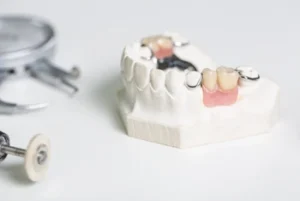 Partial dentures are made from plastic, metal, or a combination of the two, and they usually have small metal clasps that grip the natural teeth to hold them in place. Those remaining teeth and gums need to be in good health to support one, which is why they are checked first.
Acrylic partial dentures are the thickest of the three, though they are straightforward to adjust and to add to later. Cast metal frameworks are thinner and stronger, with small rests that sit on the biting surfaces and transfer chewing load into the teeth instead of the gum alone. Flexible partial dentures use a gum-coloured material with no visible metal, which matters more for front teeth than for back ones.
Gums and bone change shape slowly over the years, so any partial denture may need a reline. A reline adds material to the fitting surface so the denture matches the ridge again, and it saves remaking the whole appliance.
What to expect when you first wear one
New dentures feel bulky for a week or two while the tongue and cheeks learn where the appliance sits. Speech settles quickly for most patients, and eating takes longer.
Start with soft food, cut it into smaller pieces, and chew on both sides at once so the denture is not levered off. Harder foods can come back gradually, and the extra saliva of the first few days settles as the mouth adapts.
Sore spots are the most common early issue. They point to a pressure point that needs easing, and they are corrected with small denture adjustments. Never file or bend a denture at home, and wear it for a few hours before the appointment so the sore area can be identified.
Inserting and removing it takes practice. The denture should seat with gentle finger pressure and never be bitten into place, which can bend the clasps or break the framework.
Looking after the denture and the teeth that hold it
The clasps grip your own teeth, so those teeth carry more responsibility than before. Keeping them healthy is what keeps the denture working.
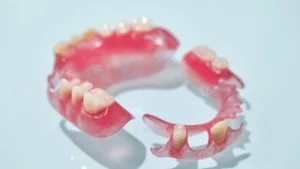 Rinse the denture and your mouth with water after eating, because food collects readily under a free-end saddle. Clean it daily by soaking it in a denture cleaning solution for the time the manufacturer recommends, then rinse it under clean water and let it air dry overnight somewhere ventilated. Leaving it in liquid longer can weaken the material, and regular toothpaste is too abrasive for denture acrylic.
Brush your remaining natural teeth morning and night with fluoride toothpaste, paying attention to where the clasps sit. Plaque gathers along that contact line, and it is the spot most often missed.
Regular denture check-ups matter as much as the daily routine. A review every six months covers the fit, the condition of the clasps, and the health of the teeth and gums underneath.
Talk to Custom Denture Clinic about replacing your back teeth
A gap at the back of the mouth is easy to live around, and the remaining teeth take on work they were not built to carry alone. At Custom Denture Clinic, our dental prosthetists assess the teeth you still have, the shape of the ridge, and the way your bite closes, then design a partial denture around all three. Our in-house lab handles adjustments, relines, and repairs, so changes can be made without a long wait. To talk through your options for replacing back teeth on one side, please call us on ( (07) 5317 1023 or (07) 5315 8076.
Frequently Asked Questions
How many teeth can a partial denture replace on one side?
There is no fixed limit. A partial denture can replace a single molar or every tooth behind the canine, provided enough healthy teeth remain elsewhere to hold it. Once too few natural teeth are left to grip, a full denture becomes the more practical option.
What affects the cost of a partial denture for back teeth?
The main factors are the number of teeth replaced, the base material, and the clasp design, since a cast metal framework involves more laboratory work than an acrylic base. An accurate figure only comes from an assessment and a written quote. Many health funds contribute under major dental cover.
Do I have to wear a partial denture all day, or only for eating?
Most patients wear it through the day and take it out at night. Wearing it only at mealtimes tends to make it feel foreign each time it goes in. Your prosthetist will advise on the routine that suits your design.
Can more teeth be added to the denture later if I lose another one?
Sometimes. An acrylic base can often have a tooth added without remaking the whole appliance. Cast metal frameworks are harder to modify, because the design is built around specific teeth. If other teeth are already under question, that is worth raising at the design stage.
How long does it take to have a partial denture made?
Expect several appointments across a few weeks. The process runs through impressions or a digital scan, a bite record, a try-in to check fit and appearance, then the final fit. A follow-up for adjustments is a normal part of the process.
References
https://www.health.nsw.gov.au/oralhealth/prevention/Pages/denture-care-factsheet.aspx
https://my.clevelandclinic.org/health/treatments/10900-dentures

If you are missing one or more teeth, but still have some remaining on your arch, your dentist may recommend a partial denture as a Read more

If you have several missing teeth but not an entire arch, you may be eligible for partial dentures. In order to support a partial denture, Read more

If you have lost a tooth, there are a few different ways that you can complete your smile. A dental bridge, a dental implant and Read more

Don't let multiple missing teeth ruin your smile. Your prosthetist can provide a removable partial denture to restore your smile and confidence and prevent the Read more
Recent Comments