
 Call Buderim
 Book Appointment

Wearing a lower denture that lifts, floats, or shifts during meals is a frustrating experience that many full denture wearers know well. The lower jaw presents unique challenges for conventional dentures: natural movements of the tongue, lips, and cheeks make it difficult to achieve a reliable seal without adhesives or implants.
Suction dentures offer a different approach. Rather than relying on pastes or surgical anchors, they use a precisely recorded impression of the mouth to create a natural, adhesive-free hold. Whether suction dentures may be suitable for you depends on several individual factors worth understanding before attending a consultation.
Quick Overview
- A suction denture (also called an SEMCD, or Suction Effective Mandibular Complete Denture) is a full lower denture designed to stay in place through a natural seal with the soft tissues of the mouth: no adhesives or implants required.
- People who are missing all their lower teeth and struggling with an unstable or loose conventional lower denture may be assessed as suitable candidates.
- The process relies on a highly detailed impression technique that records real jaw and tissue movements, which may contribute to improved stability during eating and speaking.
- Suitability and results vary between individuals based on oral anatomy, tissue condition, and bone levels. Not everyone achieves full suction, though stability is often improved regardless.
- A clinical assessment is the first step to understanding whether this technique may be appropriate for your mouth.
Below, we explain how suction dentures work, what the process involves, and what to consider before a consultation.
What Is a Suction Denture (SEMCD)?
A suction denture is a complete lower denture that holds in place through an airtight seal between the denture base and the soft tissues lining the mouth. The technique is known formally as Suction Effective Mandibular Complete Denture, or SEMCD.
Unlike conventional lower dentures, SEMCD uses a specialised impression technique that maps the natural movement of your jaw, tongue, and cheeks. It records how your mouth actually functions rather than capturing a static shape.
The seal works through cohesion. When two surfaces are held together with a thin film of liquid between them, separating them becomes difficult. In the mouth, saliva acts as that liquid, allowing the denture to hold without any adhesive product.
Dentures are made to fit each person’s mouth and often require several appointments to achieve an accurate fit. The SEMCD process takes this further, capturing dynamic movement rather than a static impression alone.
Why Is the Lower Jaw Harder to Fit?
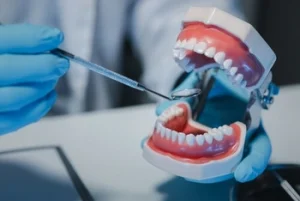 The upper jaw has a broad, stable surface area that helps conventional full dentures achieve reasonable suction. The lower jaw is different. The tongue sits within it, the floor of the mouth rises during swallowing, and the cheeks move constantly during speech and chewing.
Conventional lower dentures are shaped primarily around the bony ridge of the jaw. As that ridge changes shape over time, a normal process following tooth loss, the fit of a conventional denture may reduce, and adhesives are often introduced to compensate.
Bone shrinkage after tooth removal can cause a denture to become loose over time, sometimes requiring relining or remaking. The SEMCD technique addresses this by focusing the fit around the surrounding soft tissue rather than the bony ridge alone.
What Does the SEMCD Process Involve?
The SEMCD process differs from conventional denture fabrication in several ways. Key steps typically include:
- Clinical assessment: Your suitability for the technique is evaluated based on your oral anatomy before any work begins.
- Functional impression: You will be guided through a series of sounds and mouth movements while the impression material is in place. This records the actual borders of the usable space in your lower jaw, including tissue movement.
- Bite registration: Jaw relationship measurements are taken to ensure the upper and lower teeth meet correctly.
- Trial fitting: A trial denture is placed to check fit, occlusion, and suction before the final version is completed.
- Final insertion: The finished denture is seated and adjusted, with follow-up appointments used to refine any areas of discomfort.
No surgery is involved. The technique is non-invasive and relies entirely on the impression process.
A Considered Approach to Suction Dentures on the Sunshine Coast
 At Custom Denture Clinic, brothers Andre and Pierre are SEMCD-certified with over 25 years of individual experience in the dental industry. They carry out the full suction denture process in their in-house laboratory, which allows for careful monitoring and adjustment at each stage of fabrication.
If you are finding your lower denture difficult to manage, a consultation is a useful first step to understanding whether suction dentures may suit your situation. Individual outcomes depend on your oral anatomy, tissue condition, and other clinical factors, all of which are assessed before any treatment proceeds.
To arrange an appointment, call our Buderim location on (07) 5317 1023 or our Caloundra location on (07) 5315 8076.
Frequently Asked Questions
Do suction dentures require surgery or implants?
No. The SEMCD technique is entirely non-surgical. It uses a specialised impression method and precise fabrication process to create a seal through the natural relationship between the denture and your soft tissue. No implants or adhesive products are needed.
Who is a suitable candidate for suction dentures?
Suction dentures are designed for people who are missing all their lower teeth and wear or require a full lower denture. A clinical assessment is needed to determine whether your oral anatomy, specifically your soft tissue and jaw structure, is suited to the technique. Suitability can only be confirmed at a consultation.
References
Better Health Channel. (2022). ‘Dentures’. Better Health Channel, 20 May. Melbourne, VIC: Victorian Government Department of Health. https://www.betterhealth.vic.gov.au/health/conditionsandtreatments/dentures
Healthdirect Australia. (2025). ‘Dentures’. Healthdirect Australia, February. Canberra, ACT: Australian Government. https://www.healthdirect.gov.au/dentures


Recent Comments